Showing posts with label Tax. Show all posts

Wednesday, 18 March 2015

The Australia Tax Part V: Putting it all together

In the final article in this series, I'll put together all the information looked at thus far.

In the first article, I used a few case-in-point examples to opine that we do pay substantial price premiums in Australia for a number of products.

In the second article, I looked at exchange rates. It is obvious (though that data is a bit out of date now; the Australian dollar has retreated substantially of late) that the Australian Dollar is a very volatile currency, and retailers may try to build a worst-case scenario into their pricing to avoid having to adjust prices repeatedly.

Then there's the issue of wages. A key issue here is that wages in Australia are high even by developed-country standards, and that they always need to be paid in local currency. So the high cost of labour for Australian-based staff (especially relevant to department stores) will always add a premium to the price. And this premium will be in Australian dollars regardless of how the imported cost of a product changes. This can severely limit the margins by which retailers can adjust their pricing.

Next, I looked at real estate. Using data from CBRE in that article, it is easy to conclude that rents in Australia are very high. 

Lastly, the issue of whether the Australian consumer can actually pay more. In most cases, and having some knowledge of economics (being a qualified accountant myself), this can be a key issue in determining pricing for local markets for a number of products. 

There's a couple of key measures used for the 'average' income. The median income is a good one (I'm not going into the technicalities of why and how). Australian Bureau of Statistics in this publication has the average income at $58,817 per year (scaled from $1128 per week by a factor of 52.143). 

Median income is harder to come by, but this article in ABC RadioNational says it's about $55,000 or thereabouts. They peg the mean average at AU$75,000.

Whichever way we look at it, it's obvious that Australians earn quite a fair bit. According to NATSEM, the average Australian household has a median disposable income of $43,100 in US Dollar equalised terms. More extensive comparison of household incomes is very difficult because of the differences in exchange rates and purchase parity.

Which essentially means this in laymen's terms: we earn a substantial amount of money.

So all-in-all, a volatile exchange rate, high wages, high rents, and the consumer having more disposable income make for a recipe where we end up with more load on out credit cards when buying things. But more income means we don't necessarily have trouble keeping up with it.

Does this mean I endorse or condone high pricing beyond what can be reasonably explained by all these factors? No. And a lot of products are still priced at levels where even all these factors combined dont account for the entire difference in price.


Saturday, 2 November 2013

The Australia Tax III: Costs of Doing Business

Carrying on from the last two articles in this series, I think it is now reasonably established that we do pay a premium in Australia when it comes to prices on skincare and fragrance products. Also, the exchange rates don't really keep up with price movements, and post-2005 increases in the exchange rates of the Australian Dollar haven't really shown through in entirety at the sticker-price level. However, products launched post-2010, especially by some brands do seem to have better pricing down under than what would be historically expected.

This brings us to the next part of the issue: Are there other factors at play which limit the amount of ammunition that a retailer can have in their arsenal to pass on price reductions from exchange rates? 

There's something common across the board when it comes to luxury brands: they all rely on high levels of interaction between sales staff and the customer. You don't just walk into a Chanel Boutique and chuck things into a shopping basket like you would at Priceline. Even picking up something that you know well about would involve interacting with the sales staff at some level. It does get a little cumbersome at times not being able to simply pick up a bottle of Pureté Idéale and being on your merry way, but that's besides the point.

So here's the catch: the product itself can have its price changed to reflect exchange rates, but the costs of actually selling it, which would include paying all the lovely sales assistants, and renting the shop-floor space in all the prime locations department stores generally occupy, don't change with exchange rates. They need to be paid in local salaries regardless.

I will look at real estate and rent in another article. This time lets focus on what gets paid to the sales staff.

While most companies are quite secretive about what they pay their staff, I think a comparison of the minimum, median and average wages across a number of countries will help this comparison (Median/Mean wage are more useful for another section I'll cover later though). Australia is consistently known to have one of the highest minimum wages in the world. Here's a quick look at minimum wages for a number of countries (equalised where possible by comparing 21+ age group):

Minimum Hourly wages from various countries compiled from official sources. The blue bars show the wages in native currencies, while the overlapping pink bars show the same amounts in US Dollar equivalent.

To illustrate the relative scale, I have expressed them in current (1-Nov-2013) US-Dollar terms as well. Because these wages need to be paid exclusively in local terms, there's nothing exchange rates do to reduce these. And since this is a substantial component of the price of the product, it can explain to a point why exchange rates have limited effect on the end-user price.

There is something that really stands out: Australia has the highest minimum wage by a distance. And not surprisingly, the difference of wages is greatest between the countries Australia tends to have a large price gulf with. We have probably the highest price differential with the USA of all countries which have a minimum wage, and our minimum wage is more than twice theirs. We also have a gap of almost 50% over the UK wage, and nearly the 25% more than French and Kiwi ones.

Singapore doesnt even have regulated minimum wage (the politics of it is not of concern here).Which is potentially another good indicator of why prices over there are a fair bit cheaper than Australia (proximity to the manufacturing hubs Taiwan, Malaysia and Hong Kong is perhaps another reason).

So yes, the answer to the question is clear-cut. Part of the reason we are paying higher prices in Australia is the fact that we get paid more. While this is not quite the same chicken-or-egg conundrum that median/mean wages will pose, it does clarify the fact that the human service element of the product price in Australia is substantially higher than other comparable countries.

So the next time you notice prices in Australia and try to compare them to the US website, perhaps the realisation needs to set in that the lovely ladies who man (so to speak) the counters here are paid much more than the ones across the Pacific, and in general, we in Australia are paid more than our trans-Pacific friends.

Since the end-user price of something is the sum total of various costs over the chain, the labour cost component in Australia is fairly high, in fact it might very well be the highest in the developed world. And this reflects at every step of the process, not the just the sales assistants or checkout operators. The products get handled at customs by public servants who get paid a fair dime, then transported by people who get paid a pretty penny, and then stacked in warehouses by staff who get paid in the same proportion more than their counterparts from other countries, and so on. So it's easy to visualise how our high wages can quickly add up the costs of a product over the value chain.

But does that mean Australian retailers actually make less money? That's for another article.

Sources:
UK: gov.uk
Australia: FWA
New Zealand: Department of Labour
France: EuroStat
Singapore: Ministry of Manpower


Wednesday, 2 October 2013

The Australia Tax Part II: Exchange Rates

So in the previous write-up, I did a little holistic overview of the issue of Australians paying significantly more for the same products compared to our peers elsewhere. I personally think this is a debate well worth taking up, and this article will show part of the reason why.

The Australian Dollar has always been a relatively volatile currency. Using data from OzForex, and a little analysis in Excel, here's the graph I obtained for the Australian Dollar's exchange rate versus the US Dollar starting from Jan 1990 to Sep 2013:


Things are actually a lot simpler than they look. The blue line tracks the monthly averaged exchange rates, the red line takes yearly averages. The orange dotted line is the average over the entire 285 months, and the black lines are averages over 5-year periods.

There is significant volatility in the exchange rate, so this rules out any quick price adjustments. And here's where the 5-year averages are important. If the averages from the first 3 five-year periods are ignored (we are well past 2003 now), it's obvious that the AUD averages around 80-odd US cents over the 2004-2009 period. And from 2010 to date, it averages at parity with the Greenback. 

Prices for a number of products in Australia, especially those made by US-based companies still seem to be reflective of the lows our Dollar hit in the early 2000s. It seems that some brands still seem to take the worst-case rates rather than longer term averages.  And since majority of currency exchange contracts can be negotiated on a lock-in, forward-looking basis, this hardly seems excusable.

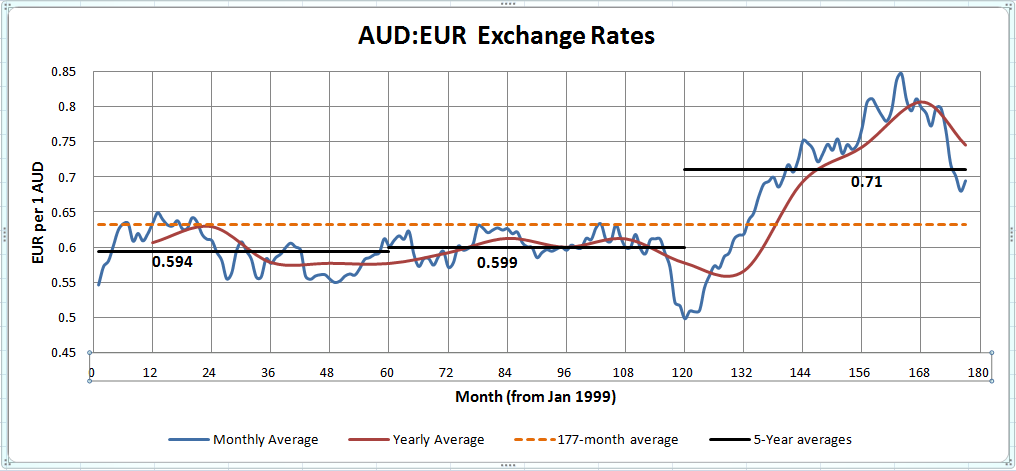
The other major source of products for the luxury sector is Europe. The Euro was instituted in 1999, and I have compiled a graph of the EUR vs the AUD here:


The AUD remained rather stable against the Euro still the late 2000s. From 2010 onwards, it really has shot up, and has remained high owing to a number of economic and geo-political causes. 

Lastly, lets have a look at the British Pound vs the AUD:


The Aussie Dollar shows a very similar pattern against the British Pound as it does against the Euro.

I am not going to dwell on why this whole pattern is exhibited; the technicalities of how and why exchange rates move is irrelevant here. The question then is: have prices in Australia reflected the fact that for the last 5-odd years, our Dollar has clocked in much higher value than its historical average would be? The distance between the orange dotted line and black lines for the 2010-onwards period is significant for every single currency. So have the Australian retailers adjusted for this, and passed some of this on to the consumer?

Yes and No. While prices for a number of brands have retreated towards more sane levels, many brands still seem reluctant to adjust prices outright. Anecdotal evidence based on my personal observation points to other methods: Gift-with-purchase (GWP) offers, bundles and packages have become a lot more common since the Aussie Dollar became dearer. This is one way of increasing the value the customer gets for his dollar while paying the same. 

Some brands, however, keep stubbornly high prices (Chanel for example). Chanel's female perfume range sells in Australia for over twice the US-market price. Even if the exchange rate against the Pound is used, a 150ml bottle of Eau Premiere should be about AU$175. The Australian price at retail is AU$70 more than that. However, the exchange rate over the 15-odd years before that would give a price of about AU$250. So they do have an excuse here.

Estee Lauder's entire lineup has a price premium in Australia of around 50% over their UK/USA pricing, sometimes even clocking in at twice the price here. Their subsidiary brands like La Mer (USD250 to AUD 365 for their "Oil Absorbing Lotion" as a singular example), Clinique (converting USD to AUD at about 2 to 1, and GBP to AUD at about 2.5 to 1), Tom Ford (converting Pounds at about 2:1) and Donna Karan to name a few are still almost obscenely overpriced here.

Singling out more and more brands is very possible, as almost every brand seems to see Australians as "soft-touches" who can be charged higher prices. However, there's hardly a need to list them. Almost every brand, in one way or the other is guilty. Cue L'Oreal's new "Shine Caresse" lip colours costing US$10 in The States, and AU$25 in Australia. Or YSL's "Cinema" costing GBP81 in the UK and AU$195 in Australia for 90ml. Brands from LVMH are similar.

There is another problem: newer product releases from the L'Oreal group (and to an extent other brands as well) seem to have better pricing. The older products seem to be stuck at the prices from the early 2000s; there is a distinct reluctance to lower sticker prices in this segment of the market, which also leads to situations where some products have much higher price premiums in Australia than others. Even if taking into account costs of freight to Australia, I think UK prices make for a decent comparison because they include 20% tax (VAT) compared to 10% for us (GST).

So this does settle one issue quite clearly: For the most part, we in Australia do pay a sizeable price premium compared to other countries if the exchange rate is the only factor taken into account. I have taken due care of not using instantaneous exchange rates; I have used the 5-year averages instead. Some of the prices we pay could be excusable at 80 US cents for every dollar, but not even close for parity.

For products that originate from Europe, it is very possible that the currently high position of the Aussie Dollar is simply seen as an aberration rather than a long-term issue. If that is the case, European brands do have an argument, but US-based ones don't.

There's another view here: Could it be that USA pays lower prices than the rest of the world? I observed pricing for some brands unusually low in the USA compared to other regions (some Chanel products for example). But that argument holds little water considering the GCC countries pay similar prices to USA too.

All-in-all, as far as the exchange rates go, we in Australia might have been paying a moderate premium pre-2005, but post-2010 we are simply overpaying. In this case, I think as far as the nominal prices for products go, the consumers do have a very valid point.

Acknowledgement: Monthly and annual currency average exchange rates sourced from OzForex. I have no commercial affiliation with OzForex or its associates.

Tuesday, 1 October 2013

The Australia Tax Part I: A Debate Worth Having?

"Australia Tax" is a phrase used frequently to describe the price gulf that exists between identical products sold in Australia compared to other countries, particularly USA, Canada, UK and the Eurozone. I am no stranger to products being priced through the stratosphere, but there is something rather different about the Australian price differential: it is consistent, and exists across practically every segment of retail. The price premium we pay in Australia for identical products over UK, USA and the Eurozone is large enough make one think.

In this series of articles, I will try and make sense of the "Australia Tax". Luxury brands are by no means the only offenders, but they do seem to have the widest gaps between Australian and overseas pricing. And to compound issues, luxury brands often present the consumer with the problem of difficult to circumvent price boundaries.

Some companies are particularly bad offenders when it comes to price discrimination (Hello Estee Lauder Group, YvesSaintLaurent, Giorgio Armani, Elizabeth Arden, Dior and Chanel). Granted, the Australian Dollar is a volatile currency and product prices are set to take into account the worst-case scenario, but in this debate who has the right of way,the customer or the seller/distributor? I will take a look in this series at the different points of view around the issue, both from the customers' and retailers' perspectives.

I will use data from factual external sources to support arguments from both sides in this series; I intend to cover the different facets of this issue such as exchange rates, taxes, price parity etc. There's a few points to consider, and I will try and cover as many bases as possible without getting overly technical.

In this first part of the series, I take a holistic look at the issue, and consider if this debate is something worthwhile in the first place. As you will find out while reading, it very well seems to be. However, the deeper I looked into this issue, the more I realised that there is always more than one side to a story.

From the customers' perspective, the argument centres on one issue: majority of high-end brands simply have too much of a price premium in Australia. And before I get apologists throwing nonsensical excuses at me like the Chanel salespeople at one well-known department store, that "luxury brands are inherently pricey" or "we use high quality ingredients that cost a lot", let me make it clear: I am considering prices for identical products across different countries, and these excuses go right out the window for the same reason. High material costs are possible, but I don't believe your raw materials suddenly double in price for Australia-bound products, and neither does Chanel become the equivalent of Garnier in the USA when selling perfume for less than half of what we pay. 

From the sellers' side, their claims are a combination of factors leading to higher prices: high wages (indeed we have one of the world's highest minimum wages), high rents at desirable locations, high costs of freight owing to relatively small market size and isolated location, and so on. Ultimately, these costs are passed on to the customers, and that manifests as high prices for the customer at the tail end of the chain.

An oft-used complaint from customers is that prices havent moved with exchange rates; using data from OzForex, I had a look at the exchange rates of the Australian Dollar vs the US Dollar over the last 23-odd years (1990 onwards). As it seems, the retailers may have some semblance of an argument, although not strong enough to sway things entirely in their favour.

As a customer, the general idea is simple. If a product can be found cheaper elsewhere, it's a go. Online retail may be cheaper due to whatever reasons as there may be, it's not the customers' concern. If the pricing set by the vendor is seen as too high and is easy enough to bypass, a savvy customer will do it. And therein lies the rub with luxury goods: their limited distribution, and with some brands, the iron-fisted controls over the supply chain (e.g. Chanel) mean it can be incredibly hard to source products from other regions easily.

At the expense of sounding sexist, but the tendency to price-hunt, especially among the female cohort (by a distance the larger of the target audiences for most skincare/fragrance/cosmetic companies) doesn't appear to be as strong as that in males. I am seeking more concrete data to back it up, but anecdotal evidence does point to it in a few places. On a popular Australian forum for skincare and beauty products, a number of members seemed convinced that an online retailer selling products cheaper than Australian street retail was "dodgy", the fact that the prices were on par with USA notwithstanding. And there lies another problem: if the majority of consumers are not aware that a product is overpriced in Australia, why does the seller care to make prices more realistic?

There's also the age-old debate of "charge whatever the customer is willing to pay". It centres on the issue of purchase power. If customers in Australia can afford to pay more than their US counterparts, and are willing to do so, there is no incentive for the seller to price goods lower than what the customer' comfort threshold is. It is also sometimes a trade-off between margins and volume. The USA, for example is a much larger market, and retailers over there can make up for smaller profits on individual products by simply selling more.

And adding to what is now looking like a cocktail, there's manufacturing locations. Many brands have localised manufacturing facilities for certain regions, which can mean some countries get the same product a lot cheaper than others.

As is obvious by now, there's a number of different issues at play, and all have some part in determining what a product scan at the checkout for. In the next part of the series, I will look at exchange rates.